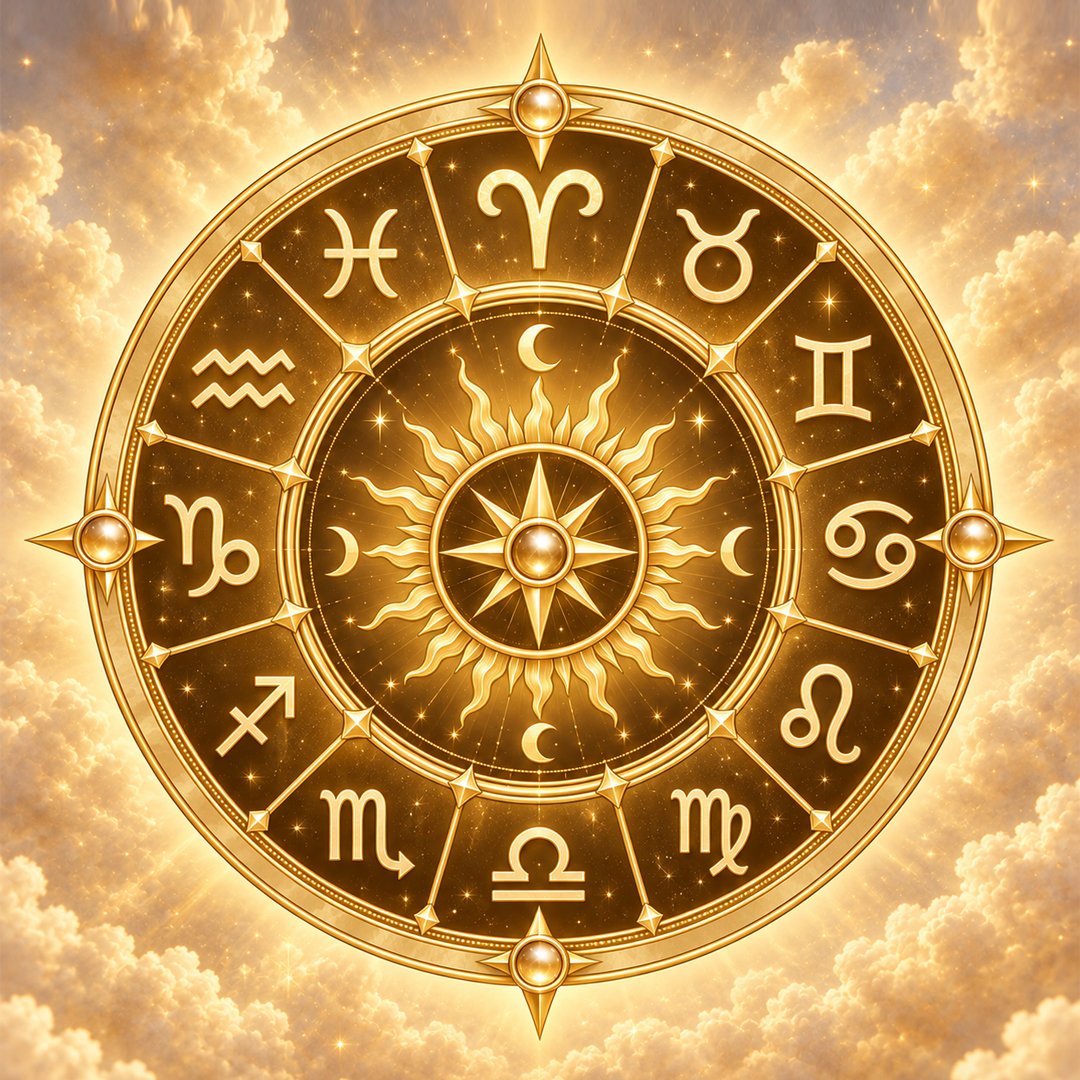
The Almanac
The machinery under every reading — four elements, three modalities, ten planets and twelve houses, each taken in turn.
Begin With Your Own Sign
Each sign is one element crossed with one modality, under a ruling planet. Start with your own and the pattern becomes obvious.
The Four Moving Parts
Astrology is assembled from four components, and this section takes them one at a time. Signs describe style, planets describe function, houses describe the department of life something happens in, and the elements and modalities sort the twelve signs into groups that behave alike.
Learn those four and a chart stops looking like a wall of symbols. Every reading anyone has ever produced is some combination of them, and most disagreement between astrologers turns out to be about weighting rather than about what the parts mean.
None of it requires belief to follow. The system is internally consistent, has been developed over roughly two thousand years, and can be read as a symbolic language whatever conclusion you eventually reach about it.
A Sensible Order To Learn Them In
Elements are the easiest way in, because four categories sort twelve signs into recognisable temperaments and the descriptions can be tested immediately against people you already know.
Modalities come next and are less intuitive, but they explain why two signs sharing an element behave so differently. Taurus and Virgo are both earth; one holds and one refines, and the modality is the reason.
Then the planets. That is the point where a chart stops being a sun sign and starts describing an individual, because ten functions distributed across twelve signs produces something specific rather than something generic.
The Part That Needs An Hour
Signs and planets follow from a birth date. Houses do not. They depend on the exact hour and the birthplace, because the entire framework rotates once every twenty-four hours.
This is the sharpest dividing line in what a reading can honestly offer. Without a time, planetary signs remain reliable and everything concerning houses, the ascendant and the midheaven is guesswork.
Our full star map collects all three inputs and computes the whole picture. Where the hour is genuinely unavailable, it names which parts of the reading are affected instead of filling them in silently.
Two Zodiacs, Neither Of Them Wrong
The Western tradition measures from the equinox: zero degrees Aries is pinned to the moment the Sun crosses the celestial equator each March. Vedic astrology measures from the stars instead, fixing its zodiac to the constellations that give the signs their names.
The Earth's axis wobbles over a cycle of roughly twenty-six thousand years, so the two have drifted about twenty-four degrees apart. A tropical Leo is frequently a sidereal Cancer.
Neither is in error. They measure from different reference points and each is internally consistent. Everything in this almanac uses the tropical zodiac, which is what essentially all Western material means by a sign.
The Claims It Does Not Make
Nothing here predicts events. The tradition describes dispositions, tendencies and symbolic relationships, and its more careful practitioners have been saying so for a very long time.
It is also not a science, causes nothing, and offers no basis for a decision about health, money or law. Where a reading appears to bear on any of those, it has left the ground the tradition actually stands on.
Read as a symbolic system for thinking about temperament, it is old, coherent and occasionally illuminating. Read as a forecast, it is neither reliable nor what its own better practitioners have ever claimed for it.