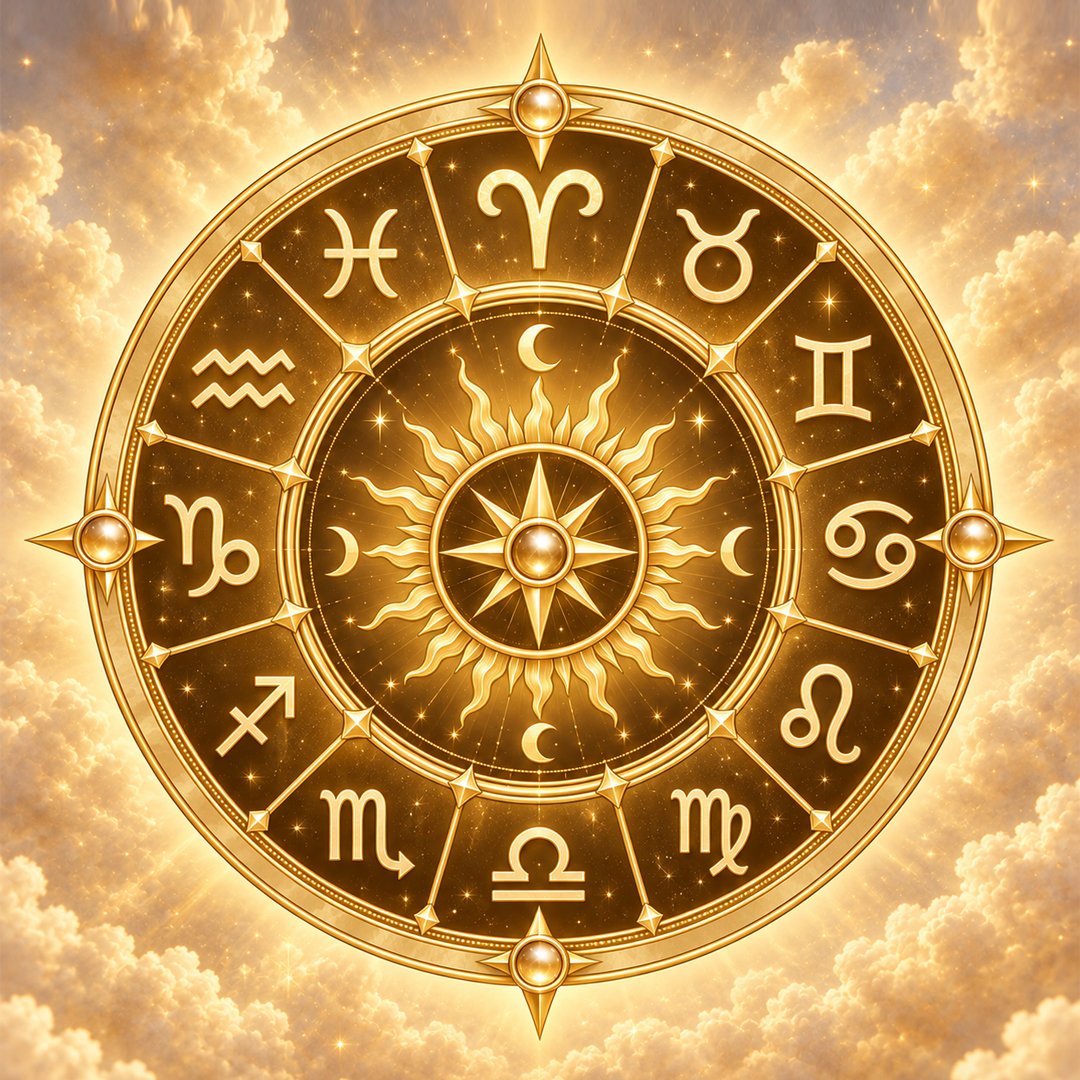
The Full Star Map
Ten bodies, the ascendant, the midheaven and the complete ring of houses — computed from the exact moment and place you arrived, then drawn as a wheel.
Your birth details never leave your browser. The chart is worked out on your own device, and nothing reaches us or gets stored.
How this chart gets computed
Positions come from standard orbital theory and are computed in your browser rather than read from a table, which puts them well inside what chart reading needs. Houses are a different matter: they depend on an accurate hour, an accurate place, and on which house system is being used.
Houses are divided by Placidus, the most widely used system in Western astrology. It cannot be computed above the polar circles, so charts from those latitudes fall back to equal houses and say so on the page.
If you need arc-second accuracy — rectification, or timing to the minute — use a professional ephemeris. This chart is built for reading, not for that.
What A Full Chart Adds
A sun sign is one placement out of ten. A full chart plots all ten bodies across twelve signs and twelve houses, marks the angles between them, and draws the wheel.
That is considerably more structure, and it is the difference between a description written to fit a twelfth of humanity and one that describes a particular temperament with real specificity.
It is also where most of the interesting contradictions live — the places where two parts of a chart pull against each other, which is usually the most recognisable thing in a reading.
Three Inputs, Three Jobs
The date establishes where the planets sat. The place establishes your horizon. The hour establishes how far the wheel had turned.
Each does distinct work, and the third is the one people most often lack. Omit the hour and the planetary signs survive intact while the entire house framework becomes guesswork, because the houses complete a full rotation every twenty-four hours.
Birth certificates commonly record the time, and the office that issued yours can usually supply a copy. It is worth the enquiry before settling for a partial chart.
What Survives Without An Hour
More than people expect. Nine of the ten bodies are reliable from a date alone — only the Moon moves fast enough for half a day to matter, and even then it changes sign on only about one birthday in three.
What is genuinely lost is three things, all consequences of the same fact: the ascendant, the midheaven and all twelve houses depend on the local horizon, which rotates completely in a day.
This map says which parts of the reading are affected rather than filling them in silently, which is the behaviour the situation actually calls for.
Reading It In Order
Start with the big three — Sun, Moon and ascendant — because they carry the most weight and they answer three different questions.
Then the personal planets: Mercury for thinking, Venus for attraction, Mars for pursuit. Each sits in a sign that describes the manner in which that function operates.
Then houses, if you have them, and aspects. Where two parts of the chart contradict each other, do not resolve it. The contradictions are usually the most accurate thing in the reading.
How It Is Computed, And Where
Every position here is calculated from published astronomical algorithms rather than read from a table, which is what allows a cusp birthday or a moon-sign boundary to get a determinate answer.
The whole calculation runs in your browser. Your birth date, hour and place are used to compute a result on your own machine and are never transmitted to us, never stored, and never passed to anyone.
The chart also names which house system it used, because dividing the sky into twelve is a genuine disagreement among astrologers rather than a settled question, and the same data can place a planet differently under a different system.