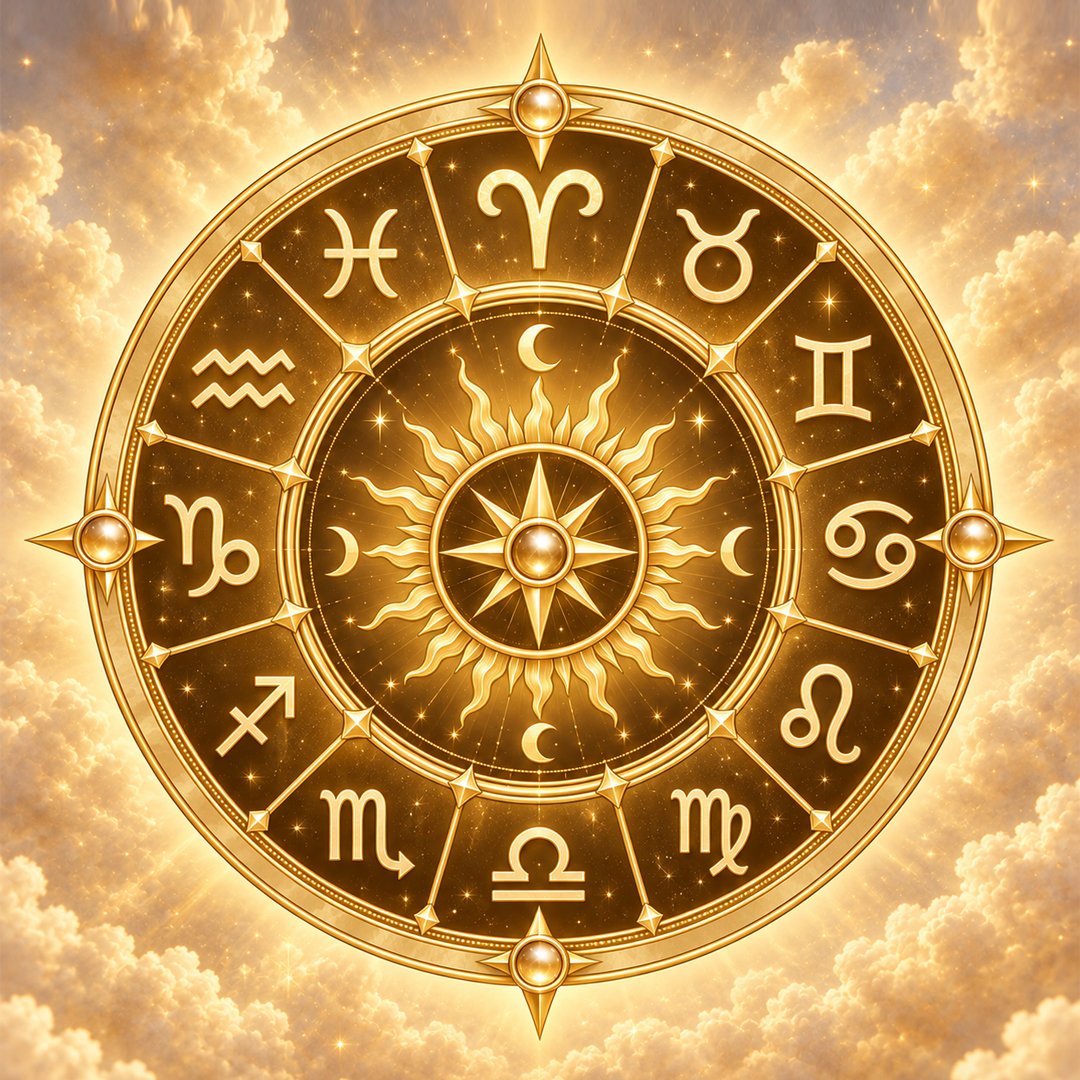
The Twelve Houses
Twelve arenas — where a placement actually plays out.
Signs Describe How, Houses Describe Where
Almost all beginner confusion about chart reading comes from mixing up two things that answer completely different questions, and separating them removes most of the difficulty at once.
A sign describes the manner of something. A house describes the arena it plays out in. Mars in Aries says you pursue things directly and impatiently. Mars in the tenth says the pursuing happens in your career. Those are two coordinates, not two competing claims.
A placement needs both before it says anything specific about an actual life. This is why a chart with no house division — which is what you have without a birth time — describes a temperament but not a biography.
Where The Twelve Come From
Houses are a product of the Earth's daily rotation, and that single fact explains everything else about them.
Signs divide the Sun's yearly path into twelve; they move slowly, and everybody born in the same month shares one. Houses divide the sky as seen from one spot on the ground at one instant, and because the Earth turns once a day, the whole arrangement cycles through in twenty-four hours. Roughly two hours per house.
That is why houses demand a birth time and signs do not, and why they are the part of a chart that genuinely distinguishes two people born the same morning in the same city.
The Four Quadrants
Learning twelve houses individually is unnecessary work. They fall into four groups of three, and the groups carry the logic.
First to third: you and your immediate surroundings — appearance and manner, what you hold, the near environment of siblings, neighbours and everyday speech. Fourth to sixth: foundations and daily life — home and origins, what you make for its own sake, the routine of work and health.
Seventh to ninth: other people and the wider world — partnership and open opposition, what is shared and what transforms, the far horizon of travel, study and belief. Tenth to twelfth: public life and what lies behind it — career and standing, the wider circle, and finally solitude and the unconscious.
Houses With Nothing In Them
A frequent worry and an unnecessary one. Ten bodies spread across twelve houses guarantees that at least two will be empty in every chart ever drawn. This is arithmetic, not absence.
An empty house does not mean an empty life in that department. It means the area is not a site of particular tension or emphasis, which is frequently rather comfortable.
The tradition reads an empty house through the sign on its cusp and through wherever that sign's ruler sits. The area is still described. It simply is not shouting.
The Disagreement About Dividing The Sky
Splitting the sky into twelve sounds as though it should have one answer. It does not, and this is the most substantive live disagreement in chart calculation.
Placidus, the most widely used system, divides by time and produces houses of markedly unequal size — extreme at high latitudes, where some become very large and others very small. Whole Sign, the oldest approach, gives each house one entire sign and avoids the distortion completely. Koch, Equal and Campanus divide differently again.
The consequence is real: the same birth data can place a planet in the ninth house under one system and the tenth under another. That is not a rounding error, it is a different reading, and a careful source states which system it used rather than presenting one as the only option.
Reading A House Properly
Three things, in this order. Which sign sits on the cusp, which gives the manner. Which planets are inside, if any, which gives the emphasis. And where the ruler of the cusp sign has ended up, which says where the matter ultimately leads.
That third step is the one beginners skip, and it is often the most informative. A second house ruled by Mars, with Mars sitting in the ninth, describes money that follows from travel or study rather than from anything in the second house itself.
For the full division computed from your birth date, hour and place, use the full star map — which names the house system it used, for the reasons set out above.